
Monday, November 2, 2026 From rOpenSci (https://ropensci.org/blog/2026/11/02/champions-histories-carolina-pradier/). Except where otherwise noted, content on this site is licensed under the CC-BY license.
We started this article as an interview series with Champions from our program, and we decided to publish for our 15th anniversary series. This is the interview with Carolina Pradier, main maintainer of the eph package.
Carolina Pradier has long worked to make the world a more equitable place. Her doctoral research focused on inequalities in science with a focus on the mechanisms that structure gender inequality in the Latin American scientific community. 1 She is also part of Ecofeminita (Asociación Civil Economía Feminista), an interdisciplinary organization created and led by women. Carolina has a degree in Economics from the University of Buenos Aires and a holds a Master’s degree in Social Sciences of Work from the Faculty of Social Sciences of the University of Buenos Aires. She is a PhD candidate in Information Science from the University of Montreal and teaches at post-secondary institutions.
As a researcher, Carolina was part of the Center for Studies on Population, Employment and Development and now works for the UNESCO Chair on Open Science. She also is the maintainer of the eph R package, whose objective is to facilitate working with the Permanent Household Survey data.
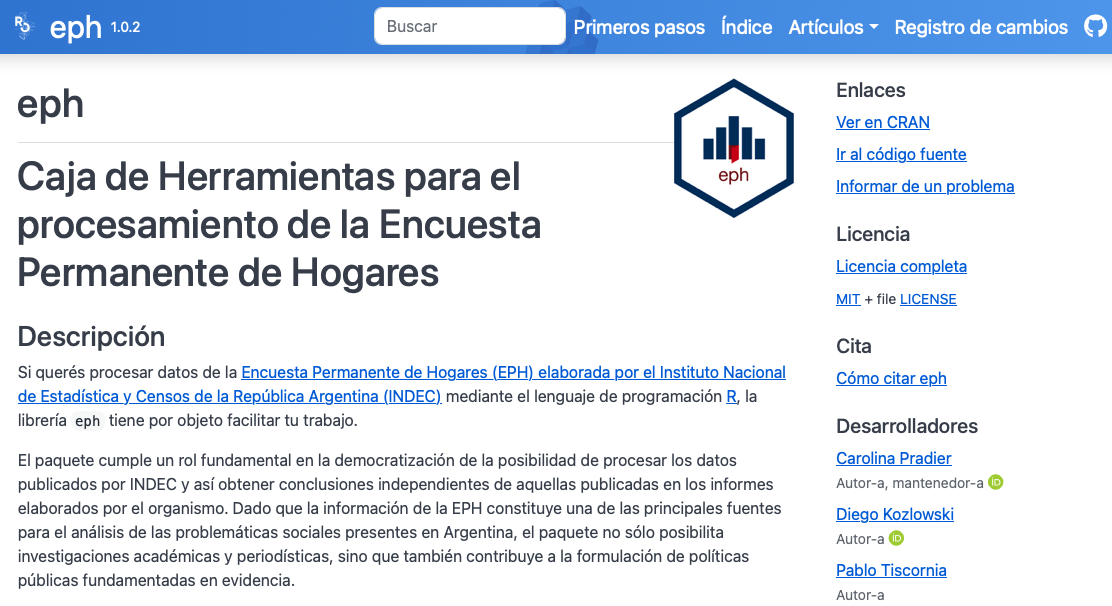
Official documentation of the eph package
🔗 rOpenSci
Carolina’s encounter with the rOpenSci Champions Program seemed natural. Her goals and those of the organization were aligned. In her application to the Champions Program she expressed:
I would like to be part of the rOpenSci Champions Program to improve my skills as a developer, as well as to improve my abilities to teach and communicate these skills."
Next followed over 12 months of training. Through the coaching, mentoring, and exposure to colleagues, Carolina received information on tools and processes, as well as advice and feedback to improve her package. She was also able to develop her communication skills and feel more confident in communicating more effectively with the people who use eph.
Exchanges and meeting with other people made her work easier, and helped her stay organized and anticipate future problems she might encounter:
I think I felt great when we finished the training and I started to work closely with my mentor, we had a good relationship and we could work very well and efficiently."
In addition to being selected to participate in the rOpenSci Champions Program through the rOpenSci application, Carolina had already gone through a previous selection. The rOpenSci Champions Program accepts only individual applications. Therefore, when Carolina’s team wished to participate, her colleagues encouraged her to participate on behalf of the team.
During the program, Carolina developed different events to help disseminate her work, share it with others, and invite them to get involved in open science. This idea was also present in the objectives that Carolina expressed in her first contact with rOpenSci:
One of my main motivations is to bring new tools to the communities of social scientists in which I actively participate in order to strengthen our capacities to transform reality."
It was with this goal that Carolina organized an event in Spanish with news and ideas for the use of the eph package. This achieved a double objective: sharing content about R packages in Spanish and bringing more people closer to the R and open science community.
Carolina also participated in a Community Call on the rOpenSci Champions Program where she shared her experiences as a champion, co-hosted a co-working session about Building your first R package, and joined as a mentor for the cohort 2025-2026 of the Champions Program.
🔗 Perfecting a job well done
The eph package processes data from the Permanent Household Survey (INDEC) in Argentina to replicate or conduct independent analyses from those published in the reports prepared by the government agency. It also allows the analysis of different categories and indicators not provided in the official reports. Carolina explained that throughout the program they managed to improve the package:
“We tried to improve the quality of the code (reliability and efficiency), we improved the documentation and created new functions.
They also worked hard to translate the documentation and make it more accessible to Spanish-speaking users. The rOpenSci peer review process showed how a rigorous approach can also be welcoming and kind.
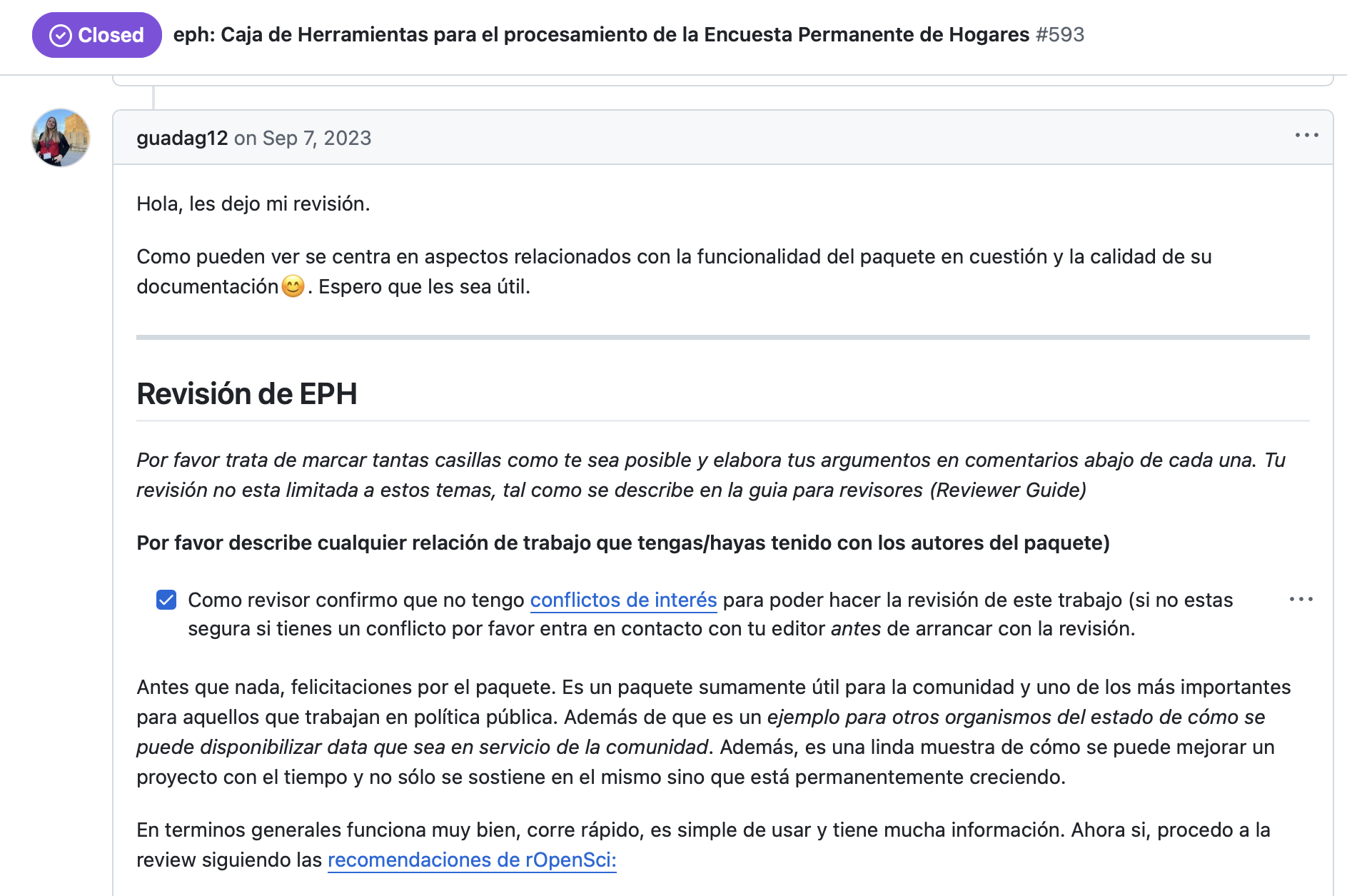
Open, transparent and friendly commentary on the rOpenSci peer review of the eph package.
🔗 Open Science
The eph package is a tool for academic research, journalism and evidence-based public policy formulation. The Champions Program allowed Carolina to improve the software using different points of view from peer and expert review.
Beyond improving the package itself, one of Carolina’s goals was to help increase the impact of her community’s work:
I am particularly excited about the prospect of participating in a program aimed at making the R community more inclusive. in addition, I feel that this experience would be a great opportunity as it would allow me to meet and work with highly skilled professionals whose work I deeply admire. Not only am I interested in learning from their experience, but I also believe that building these networks can help increase the impact of my community’s efforts and access new sources of support.”
Some existing uses of eph show the kind of impact Carolina hopes the package can have. At EcoFeminita, the civil association Carolina is part of, the Ecofemidata team uses eph to provide data on gender inequality through indicators, statistics, and reproducible thematic reports. Among other uses, the team maintains an app that analyzes the labor market, income, time use, and domestic work.
The package has also inspired programmers, data scientists, and people from other disciplines to develop the PyEPH library, which has a similar purpose to the eph package in R but is used and supported by people in the Python data community. As eph keeps improving and the network around it grows, Carolina hopes to see more experiences like these.
🔗 Beyond learning: building with a community
Carolina Pradier was able to improve her R skills, acquire new skills, and offer a multilingual package so that more people can access open science. Experiences with her mentor, her peers, the people who participated in the review process, and the people who use the package were a great contribution to learning and personal growth. Her participation in the Champions Program was the beginning of a network of links that promise new projects.
I always had someone to talk to to help me solve problems; it was never a frustrating process."
Carolina is now handing over maintenance of eph to a new maintainer. The package is used by many people and has a community around it, which is what makes it sustainable.
Shared knowledge allows us to anticipate, help and include. The more experiences like Carolina Pradier’s there are, the more shared and open open science there will be.
Three of the papers from Carolina’s doctoral thesis have already been published: Science for whom? The influence of the regional academic circuit on gender inequalities in Latin America (JASIST, 2025); How multilingual is scholarly communication? Mapping the global distribution of languages in publications and citations (JASIST, 2026); and Language hierarchies and gender inequalities: the coverage of OpenAlex and the Web of Science (Research Evaluation, 2026). ↩︎
Filed under
Suggest an edit
Open a pull request
